The Impact of Artificial Intelligence on Clinical Outcomes in Minimally Invasive Gynecological Surgery: A Systematic Review and Meta-Analysis
DOI:
https://doi.org/10.14740/jcgo1724Keywords:
Artificial intelligence, Minimally invasive gynecological surgery, Systematic review, Meta-analysis, Clinical outcomes, Robotic surgery, Computer vision, Machine learningAbstract
Background: Minimally invasive gynecological surgery (MIGS) is the standard of care for many gynecological conditions. The integration of artificial intelligence (AI) promises to enhance surgical precision and improve patient outcomes, yet a comprehensive quantitative synthesis of its clinical impact is lacking. While numerous studies have validated the technical feasibility of AI in surgery, its translation to tangible patient benefits remains to be consolidated. The aim of the study was to systematically review the literature and conduct a meta-analysis to quantitatively evaluate the impact of AI on key clinical outcomes in MIGS compared to conventional minimally invasive techniques.
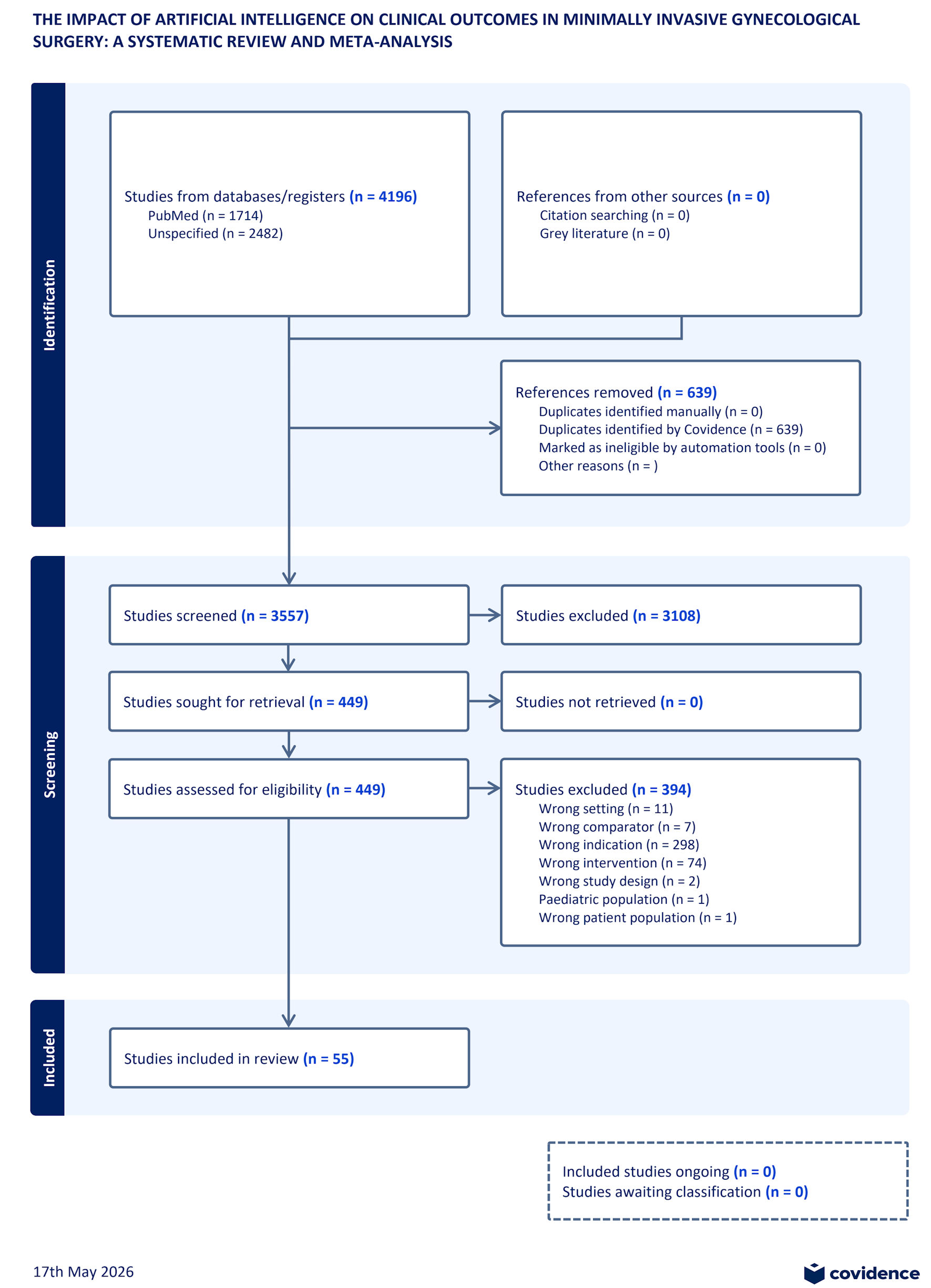
Methods: A systematic search was conducted across PubMed/MEDLINE, Embase, Scopus, Web of Science, and the Cochrane Library in accordance with the Preferred Reporting Items for Systematic Reviews and Meta-Analyses (PRISMA) 2020 guidelines. Randomized controlled trials (RCTs) and comparative observational studies comparing AI-assisted MIGS with conventional MIGS in adult female patients were included. Primary outcomes were operative time, intraoperative blood loss, postoperative complication rates, and length of hospital stay. A random-effects model was used for the meta-analysis.
Results: The search yielded 55 eligible studies (12 RCTs and 43 observational studies) involving 48,951 patients (23,150 AI-assisted; 25,801 conventional). AI-assisted MIGS was associated with significant improvements across all primary outcomes. The pooled mean difference for operative time was −21.2 min (95% confidence interval (CI), −28.5 to −13.9; P < 0.00001), and for intraoperative blood loss, it was −31.5 mL (95% CI, −40.2 to −22.8; P < 0.00001). The pooled odds ratio for postoperative complications was 0.65 (95% CI, 0.58 to 0.73; P < 0.00001), indicating a 35% reduction in the odds of complications. Length of hospital stay was significantly reduced by a mean of −0.55 days (95% CI, −0.71 to −0.39; P < 0.00001).
Conclusions: AI integration in MIGS is associated with significant and clinically meaningful improvements in patient-centered outcomes, including shorter operative times, reduced blood loss, lower complication rates, and shorter hospital stays. Future research should prioritize large-scale RCTs with standardized AI interventions and long-term follow-up.
Published
Issue
Section
License
Copyright (c) 2026 The authors

This work is licensed under a Creative Commons Attribution 4.0 International License.