

Detection of AI Influence Within Women’s Health Literature
DOI:
https://doi.org/10.14740/jcgo1638Keywords:
Women’s health research, Artificial intelligence, Large language models, Literature authorship, Obstetrics, GynecologyAbstract
Background: The extent of large language models (LLM) being used to generate or edit medical literature without disclosure remains unknown. This study hypothesizes LLM influence and aims to quantify possible usage and disclosure rates in recent women’s health publications.
Methods: Eighty women’s health journals were selected at random, and the first 20 publicly available abstracts from January through December 2025 were included from each journal. After selection for inclusion, a total of 1,600 abstracts were downloaded in addition to subspecialty categories, journal impact factor, and continent of corresponding authors. Abstract text was then individually inputted into GPTZero, an artificial intelligence (AI) detection software, to quantify percentages of sourced text that were human-generated, AI-generated, or AI-edited. Manuscripts with AI detected in their abstracts were then evaluated for disclosure of AI use. Source percentages were compared across subspecialties, impact factors, and continents, with significance defined as P < 0.05.
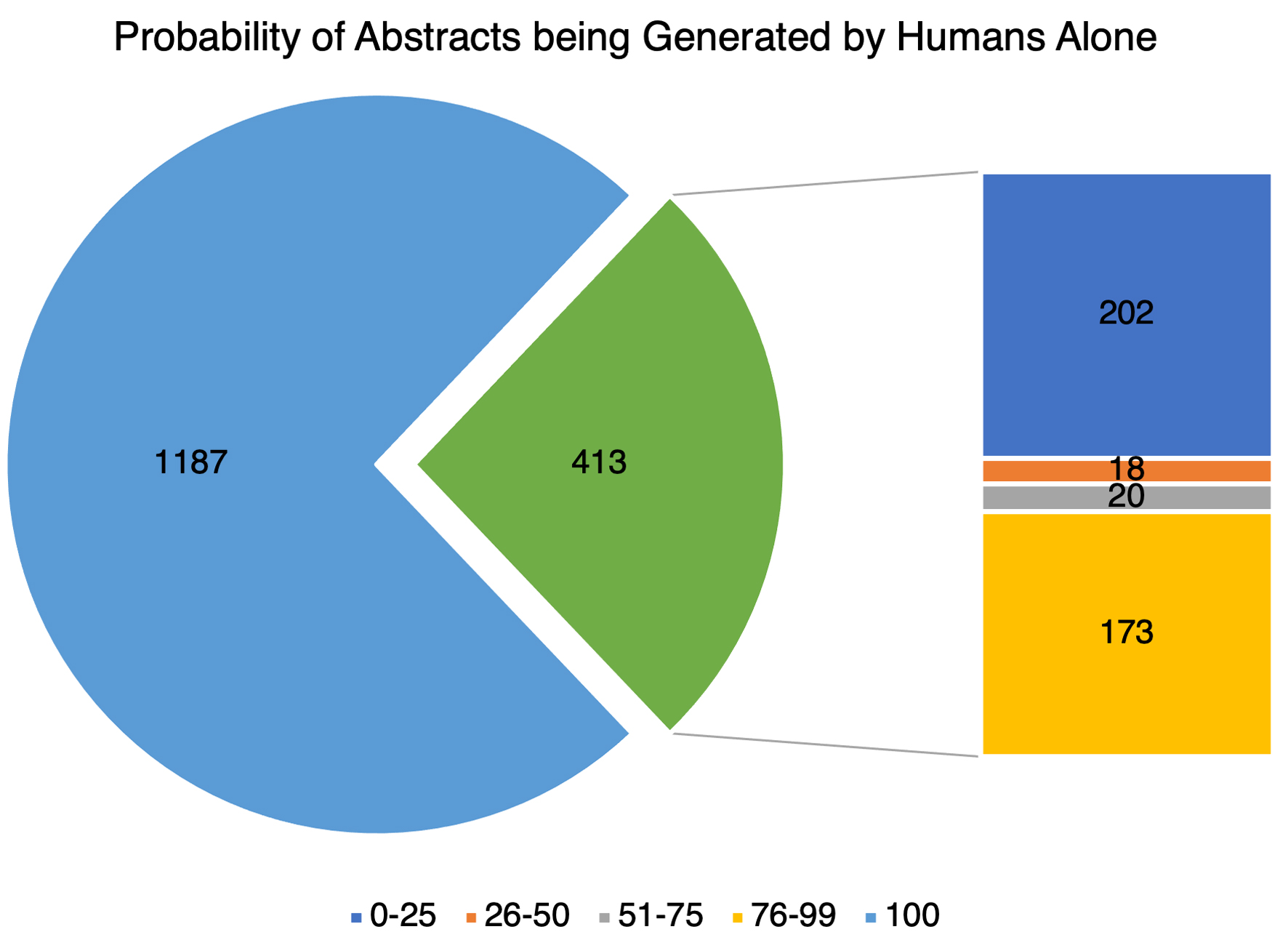
Results: Of the 1,600 abstracts, 413 (25.8%) were flagged as containing AI influence. Additionally, 79 out of 413 (19.1%) abstracts were identified as entirely AI-generated and 21 out of 413 (5.1%) abstracts disclosed AI use. Abstracts in journals related to reproductive endocrinology and infertility were most often flagged for AI influence (35%, 77/220), whereas family planning-related abstracts showed the lowest proportion (6.7%, 4/60) (P < 0.05). A weak inverse association between impact factor and AI use was observed, but this relationship was not significant and explained only 4% of data variability for AI use (R2 = 0.04). No difference across continents and AI detection was found (P = 0.45).
Conclusion: Findings suggest that AI may contribute to approximately one-quarter of published women’s health abstracts in 2025. This early signal underscores potential prevalence of LLM usage and low disclosure rates highlighting the need for clear guidelines and transparency regarding AI use in scholarly communication. Ongoing discussions are needed to outline responsible implementation to harness AI’s potential while maintaining the integrity of medical research.
Published
Issue
Section
License
Copyright (c) 2026 The authors

This work is licensed under a Creative Commons Attribution 4.0 International License.