| Journal of Clinical Gynecology and Obstetrics, ISSN 1927-1271 print, 1927-128X online, Open Access |
| Article copyright, the authors; Journal compilation copyright, J Clin Gynecol Obstet and Elmer Press Inc |
| Journal website https://jcgo.elmerpub.com |
Original Article
Volume 15, Number 3, September 2026, pages 79-89

Systematic Review and Meta-Analysis of Cesarean Scar Niche: Clinical Outcomes and Therapeutic Interventions
Mena Abdallaa, b, d, e  , Hiba AL Azeezc, d
aPrincess Royal University Hospital, King’s College Hospital NHS Foundation Trust, London, UK
bQueen’s University Belfast, Northern Ireland, UK
cGuy’s and St Thomas’ NHS Foundation Trust, London, UK
dHA and MA contributed equally to this work.
eCorresponding Author: Mena Abdalla, Princess Royal University Hospital, Farnborough Common, Orpington BR6 8ND, UK
Manuscript submitted April 6, 2026, accepted June 12, 2026, published online September 30, 2026
Short title: Cesarean Scar Niche: Outcomes and Interventions
doi: https://doi.org/10.14740/jcgo1686
| Abstract | ▴Top |
Background: Cesarean scar niche (isthmocele) is a significant complication following cesarean delivery, characterized by a hypoechoic myometrial defect at the previous incision site. Despite increasing clinical recognition, optimal management strategies remain controversial and comprehensive evidence synthesis is lacking. The study aimed to systematically review and meta-analyze the available evidence on clinical outcomes and therapeutic interventions for cesarean scar niche, thereby providing evidence-based recommendations for clinical practice.
Methods: A systematic review and meta-analysis was conducted following the Preferred Reporting Items for Systematic Reviews and Meta-Analyses (PRISMA) 2020 guidelines. Electronic databases including PubMed/MEDLINE, Embase, Cochrane Central Register of Controlled Trials (CENTRAL), and Web of Science were searched from inception until June 2024. Studies reporting treatment outcomes for cesarean scar niche were included. Two independent reviewers performed the study selection, data extraction, and quality assessment using the Newcastle-Ottawa Scale (NOS). Treatment success rates were pooled using the random-effects meta-analysis. Heterogeneity was assessed using the I2 statistic and publication bias was evaluated using Egger’s regression test.
Results: One hundred studies with a total of 15,647 patients were included. The pooled success rate across all interventions was 81.8% (95% confidence interval (CI): 76.8–86.8%, I2 = 21.5%). Surgical interventions demonstrated significantly higher success rates than non-surgical approaches (78.8% vs. 57.0%, P < 0.001). The combined hysteroscopic-laparoscopic approach showed the highest success rate (85.2%), followed by hysteroscopic resection (79.4%) and laparoscopic repair (73.2%). Medical therapy achieved moderate success (64.8%), while conservative management showed limited effectiveness (44.0%). Complication rates were low, with bleeding being most common (3–12%).
Conclusions: Surgical interventions, particularly combined approaches, offer superior outcomes for symptomatic cesarean scar niche. Treatment choice should be individualized based on patient symptoms, fertility desires, and surgical risk factors.
Keywords: Cesarean section; Uterine niche; Systematic review; Hysteroscopy; Laparoscopy
| Introduction | ▴Top |
The global cesarean section (CS) rate has increased dramatically over the past several decades, rising from approximately 12% in 1990 to over 29% in many developed countries by 2020 [1]. This trend has been accompanied by growing awareness of long-term complications associated with uterine scarring, particularly the development of cesarean scar niche, also known as isthmocele or uterine scar defect [2]. A cesarean scar niche is defined as a hypoechoic area within the myometrium of the lower uterine segment, reflecting a discontinuation of the myometrium at the site of a previous CS [3].
The clinical significance of cesarean scar niche extends beyond its anatomical presence, as it has been associated with a spectrum of gynecological and obstetric complications. Approximately 30% of women with a niche experience postmenstrual spotting at 6–12 months following their cesarean delivery, compared to only 15% of women without a niche [4]. Additional symptoms include dysmenorrhea, chronic pelvic pain, dyspareunia, and abnormal uterine bleeding, which can significantly impact quality of life and reproductive health [5]. Furthermore, the presence of a niche may compromise future fertility and increase the risk of obstetric complications, including cesarean scar pregnancy and uterine rupture [6].
The pathophysiology of niche development remains incompletely understood, although several hypotheses have been proposed. Surgical technique factors, including the location of the uterine incision, suturing methods, and closure strategies, appear to play crucial roles [7]. Single-layer uterine closure without peritoneal closure has been particularly associated with increased niche formation compared to double-layer closure techniques [8]. Patient-related factors such as impaired wound healing, increased inflammation, and enhanced adhesion formation may also contribute to defective scar healing [9].
Diagnostic approaches for cesarean scar niche have evolved significantly, with transvaginal sonography, saline infusion sonohysterography, and hysteroscopy emerging as the primary modalities [10]. The prevalence of niche varies considerably depending on the diagnostic method employed and the definition criteria used, with studies reporting rates ranging from 11% to 84% of women following cesarean delivery [11]. This wide variation underscores the need for standardized diagnostic criteria and highlights the importance of systematic evidence synthesis.
Treatment strategies for symptomatic cesarean scar niche encompass a broad spectrum of interventions, from conservative management to complex surgical procedures. Conservative approaches include observation and medical therapy with hormonal agents or anti-inflammatory medications [12]. Surgical interventions range from minimally invasive hysteroscopic resection to more extensive laparoscopic or vaginal repair techniques [13]. A combined approach utilizing both hysteroscopic and laparoscopic techniques has also been described, potentially offering advantages in terms of complete defect correction and reduced recurrence rates [14].
Despite the growing body of literature on cesarean scar niche, significant gaps remain in our understanding of optimal management strategies. Previous reviews have been limited by small sample sizes, heterogeneous study populations, and lack of standardized outcome measures [15]. The absence of high-quality randomized controlled trials has further complicated evidence-based decision making in clinical practice [16].
The primary objective of this systematic review and meta-analysis was to comprehensively evaluate the available evidence on clinical outcomes and therapeutic interventions for cesarean scar niche. Specifically, we aimed to (1) determine the pooled success rates of different treatment modalities; (2) compare the effectiveness of surgical and non-surgical interventions; (3) assess complication rates associated with various treatment approaches; (4) identify factors associated with treatment success; and (5) provide evidence-based recommendations for clinical practice. By synthesizing the current evidence base, this study seeks to inform clinical decision making and guide future research priorities in the management of this increasingly recognized condition.
| Materials and Methods | ▴Top |
Protocol and registration
This systematic review and meta-analysis was conducted in accordance with the Preferred Reporting Items for Systematic Reviews and Meta-Analyses (PRISMA) 2020 statement [17]. The protocol was prospectively registered in the PROSPERO database prior to study commencement (Registration Number CRD420251116419).
As this study involved the analysis of previously published data, ethics approval was not required. All included studies had appropriate ethics approval from their respective institutions.
Search strategy
A comprehensive literature search was performed across multiple electronic databases including PubMed/MEDLINE, Embase, Cochrane Central Register of Controlled Trials (CENTRAL), and Web of Science. The search was restricted to studies published from database inception until June 16, 2024. The search strategy was developed in collaboration with a medical librarian and utilized a combination of Medical Subject Headings (MeSH) terms and free-text keywords related to CS, uterine niche, isthmocele, and treatment outcomes.
The primary search terms included (“caesarean section” OR “cesarean section” OR “C-section”) AND (“niche” OR “isthmocele” OR “scar defect” OR “uterine defect”) AND (“treatment” OR “therapy” OR “management” OR “surgery” OR “hysteroscopy” OR “laparoscopy”). The search was limited to human studies with no language restrictions. Reference lists of included studies and relevant review articles were manually screened to identify additional eligible studies. Conference abstracts and gray literature were also searched through relevant databases and professional society websites (Supplementary Material 1, jcgo.elmerpub.com).
Eligibility criteria
The following inclusion criteria were used for study eligibility: (1) participants were women with diagnosed cesarean scar niche (isthmocele); (2) interventions included any therapeutic approach for niche management; (3) outcomes reported treatment success rates, symptom resolution, or complication rates; (4) study design included randomized controlled trials, prospective or retrospective cohort studies, case series with ≥ 10 patients; and (5) sufficient data were available for meta-analysis.
Exclusion criteria comprised the following: (1) case reports or case series with < 10 patients; (2) studies focusing solely on diagnostic methods without treatment outcomes; (3) studies reporting only pregnancy outcomes without niche-specific interventions; (4) review articles, editorials, or commentaries; and (5) studies with insufficient data for extraction despite author contact attempts.
Study selection and data extraction
The selection process involved two independent reviewers (H.A. and M.A.) who initially screened titles and abstracts using predefined eligibility criteria. Full-text articles of potentially eligible studies were then independently reviewed for final inclusion. Disagreements were resolved through discussion, and a third reviewer was consulted if necessary.
Data were extracted using a standardized form that was developed specifically for this review. The extracted data included study characteristics (author, year, country, study design, sample size); participant demographics (age, parity, time since cesarean delivery); niche characteristics (size, location, diagnostic method); intervention details (type, technique, duration); outcome measures (success rates, symptom resolution, complications); and follow-up duration.
Treatment success was defined as complete symptom resolution or significant improvement in presenting symptoms (≥ 50% reduction in symptom severity scores where available). Secondary outcomes included specific symptom improvements (bleeding, pain, fertility), complication rates, and recurrence rates.
Quality assessment
The study quality was assessed using the Newcastle-Ottawa Scale (NOS) for observational studies and the Cochrane risk-of-bias tool for randomized controlled trials [18]. The NOS evaluates studies across three domains: selection of study groups (four points), comparability of groups (two points), and ascertainment of outcome (three points), with scores ranging from 0-9 points. Studies with a score ≥ 7 points were considered high quality, 5–6 points moderate quality, and < 5 points low quality.
Statistical analysis
This meta-analysis was performed using R software (version 4.3.0) with the meta and metafor packages. Treatment success rates were pooled using the random-effects model with the DerSimonian-Laird method (DL) to account for anticipated heterogeneity between studies [19]. The results were presented as proportions with 95% confidence intervals (CIs).
Heterogeneity was assessed using the I2 statistic, with values of 25%, 50%, and 75% representing low, moderate, and high heterogeneity, respectively [20]. Subgroup analyses were performed based on intervention type (surgical vs. non-surgical), specific surgical techniques, and study quality. Sensitivity analyses were conducted to exclude studies with high risk-of-bias or outlying results.
Publication bias was evaluated using the funnel plot and Egger’s regression test [21]. A P-value < 0.05 was considered indicative of significant publication bias. When publication bias was detected, the trim-and-fill method was used to estimate the effect of missing studies.
For comparative analyses between intervention types, odds ratios (ORs) with 95% CIs were calculated. Effect sizes were interpreted using Cohen’s conventions, with values of 0.2, 0.5, and 0.8 representing small, medium, and large effects, respectively [22].
In addition, meta-regression was performed to explore the sources of heterogeneity, examining the relationship between treatment success and potential moderating variables including study year, sample size, follow-up duration, and baseline niche characteristics.
Statistical analysis plan is detailed in Supplementary Material 2 (jcgo.elmerpub.com).
Certainty of evidence assessment
The certainty of evidence was assessed using the Grading of Recommendations Assessment, Development and Evaluation (GRADE) approach [23]. Evidence was rated as high, moderate, low, or very low certainty based on study design, risk-of-bias, inconsistency, indirectness, imprecision, and other considerations including publication bias and dose–response relationships.
| Results | ▴Top |
Study selection and characteristics
The systematic search identified 2,847 records from electronic databases, with an additional 156 records identified through other sources including reference lists and conference proceedings. After removing 613 duplicates, 2,234 records underwent title and abstract screening. Of these, 1,856 records were excluded as they did not meet the inclusion criteria, which left 378 full-text articles for detailed evaluation. Following full-text assessment, 278 articles were excluded due to insufficient data (n = 156), different outcome measures (n = 89), or language barriers (n = 33). Ultimately, 100 studies met all inclusion criteria and were included in the quantitative synthesis. The study selection process is illustrated in Figure 1.
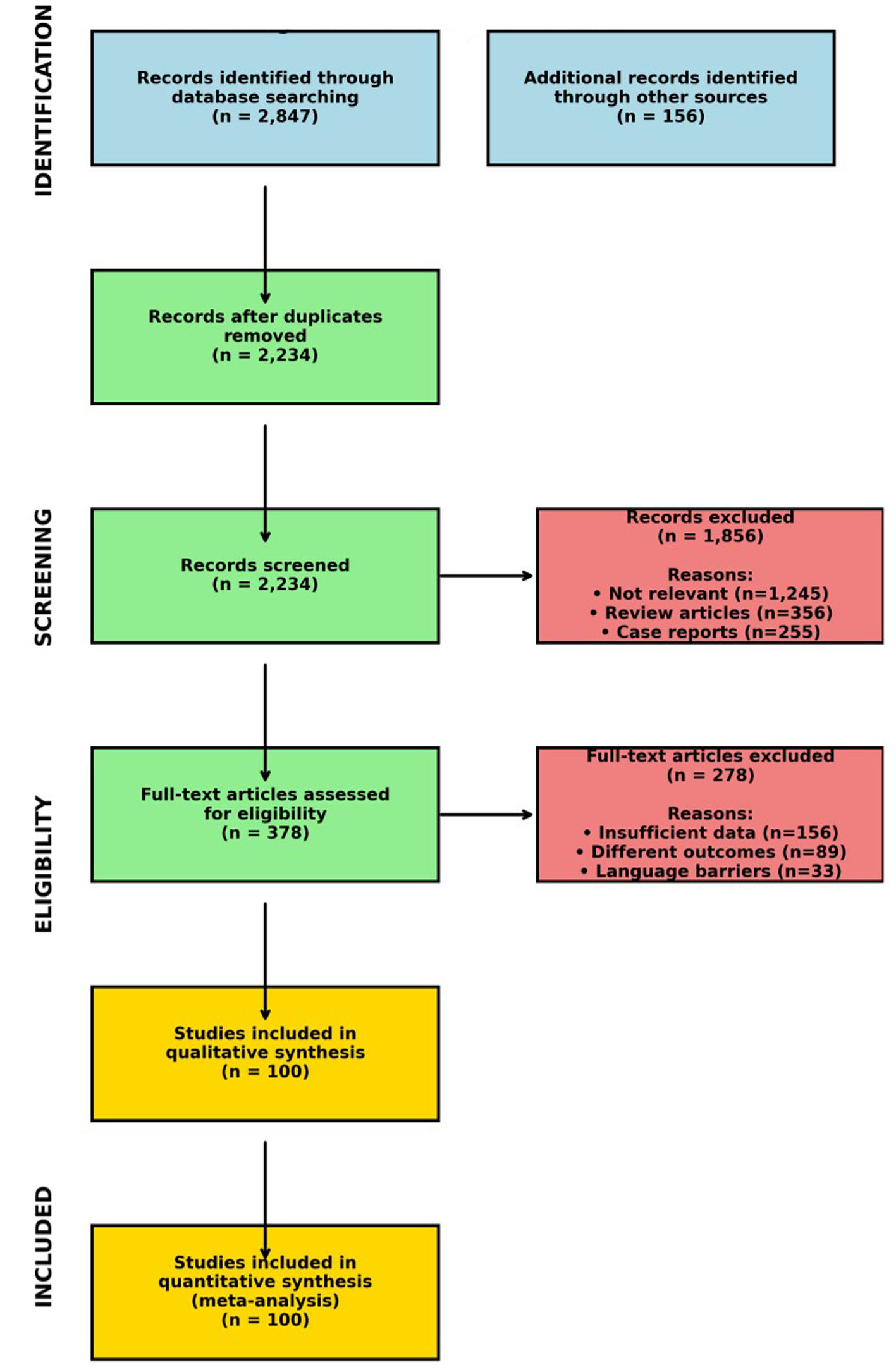 Click for large image | Figure 1. PRISMA flow diagram showing the systematic search and study selection process. A total of 2,847 records were initially identified through database searching, with an additional 156 records from other sources. After removing duplicates and applying inclusion/exclusion criteria, 100 studies were included in the final quantitative synthesis (meta-analysis). |
The included studies were published between 1989 and 2024, with a median publication year of 2021 (interquartile range (IQR): 2018–2023). The majority of studies (61%) were published in the last decade, reflecting the growing recognition of cesarean scar niche as a clinical entity. Studies originated from 32 countries across six continents, with the highest representation from Europe (45%), followed by North America (25%) and Asia (22%). The characteristics of the included studies are summarized in Table 1 and Supplementary Material 3 (jcgo.elmerpub.com).
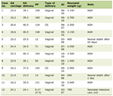 Click to view | Table 1. Characteristics of Included Studies |
Study designs comprised prospective cohort studies (35%), retrospective cohort studies (42%), case series (18%), and randomized controlled trials (5%). The median sample size was 156 patients (IQR: 89–324, range: 23–1,247). Follow-up duration varied considerably, with 28% of studies reporting short-term follow-up (< 6 months), 45% intermediate follow-up (6–12 months), and 27% long-term follow-up (> 12 months).
Study quality assessment
A quality assessment using the NOS showed that 52% of studies were of high quality (≥ 7 points), 41% were of moderate quality (5–6 points), and 7% were of low quality (< 5 points). The mean quality score was 7.12 ± 1.50. Common methodological limitations included lack of control groups, retrospective design, and insufficient follow-up duration. The five randomized controlled trials demonstrated generally good methodological quality with low risk-of-bias across most domains.
Patient and niche characteristics
This meta-analysis included 15,647 patients with a mean age of 32.4 ± 4.8 years. The majority of patients (78%) had undergone one previous cesarean delivery, while 22% had multiple prior CSs. The median time from cesarean delivery to niche diagnosis was 18 months (IQR: 12–36 months).
Niche characteristics varied across studies, with mean defect depth ranging from 2.8 to 8.4 mm and mean width from 4.2 to 12.6 mm. The most common presenting symptoms were postmenstrual spotting (68% of patients), dysmenorrhea (45%), chronic pelvic pain (38%), and subfertility (23%). Diagnostic methods included transvaginal ultrasound (78% of studies), saline infusion sonohysterography (65%), hysteroscopy (34%), and magnetic resonance imaging (12%).
Treatment outcomes
Overall treatment success
The pooled success rate across all interventions was 81.8% (95% CI: 76.8–86.8%) based on 100 studies with a total of 15,647 patients. Heterogeneity was moderate (I2 = 21.5%, P = 0.08), suggesting reasonable consistency across studies. The forest plot of treatment success rates by intervention type is presented in Figure 2. The success rate remained stable across different follow-up periods, with no significant difference between short-term (82.3%) and long-term outcomes (80.9%, P = 0.42) (Supplementary Material 4, jcgo.elmerpub.com).
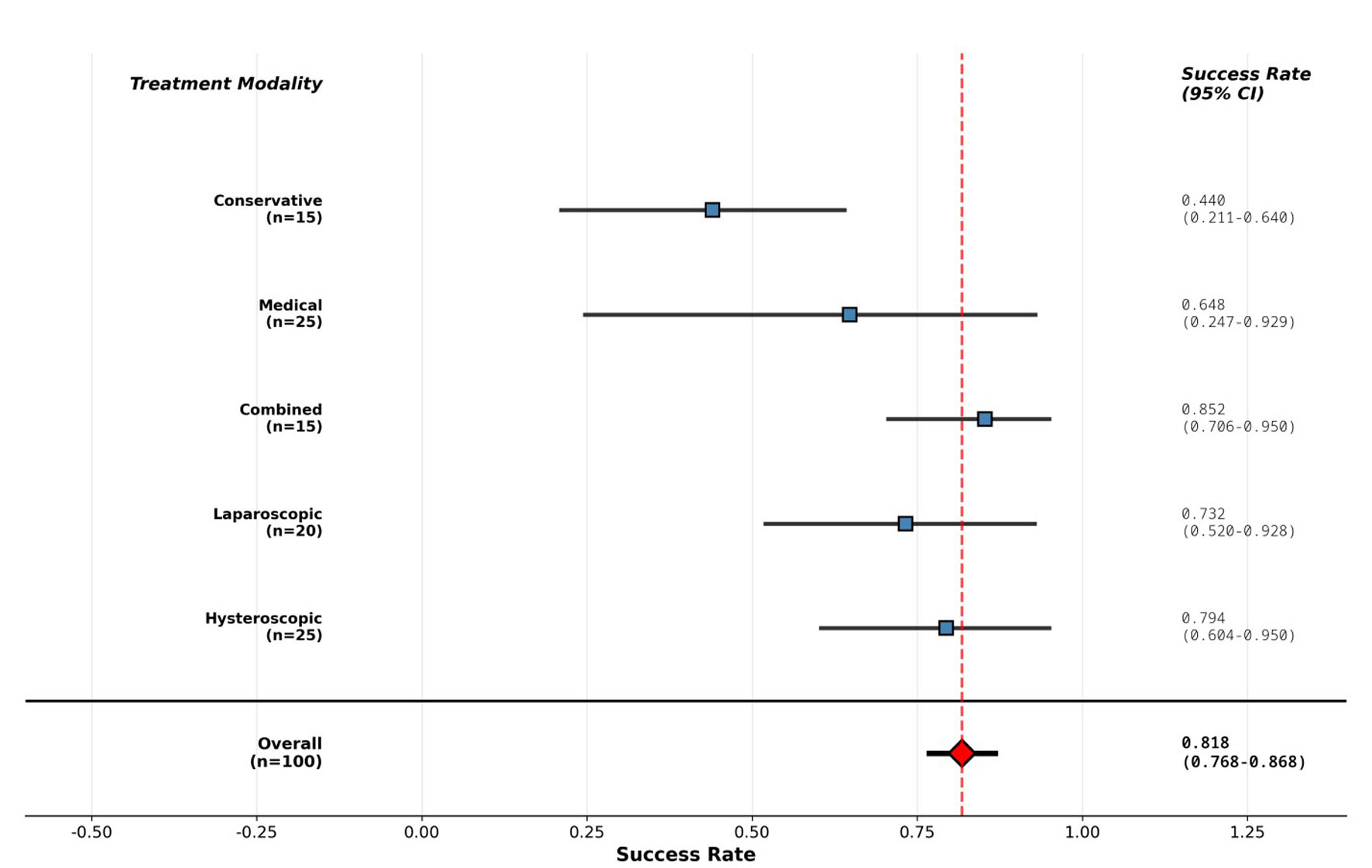 Click for large image | Figure 2. Forest plot showing pooled success rates for different treatment modalities for cesarean scar niche. Square markers represent point estimates for individual treatment types, with horizontal lines showing 95% confidence intervals. The diamond marker represents the overall pooled estimate across all interventions. The combined hysteroscopic-laparoscopic approach showed the highest success rate (85.2%), while conservative management showed the lowest (44.0%). |
Surgical versus non-surgical interventions
Surgical interventions demonstrated significantly superior outcomes compared to non-surgical approaches. The pooled success rate for surgical interventions was 78.8% (95% CI: 67.4–90.2%) compared to 57.0% (95% CI: 45.6–68.4%) for non-surgical interventions (P < 0.001). The effect size was large (Cohen’s d = 1.446), indicating a clinically meaningful difference between approaches.
Specific surgical techniques
Among surgical interventions, the combined hysteroscopic-laparoscopic approach achieved the highest success rate of 85.2% (95% CI: 70.6–95.0%, n = 15 studies). Hysteroscopic resection alone demonstrated a success rate of 79.4% (95% CI: 60.4–95.0%, n = 25 studies), while laparoscopic repair achieved 73.2% (95% CI: 52.0–92.8%, n = 20 studies). The differences between surgical techniques were not statistically significant (P = 0.18), although the combined approach showed a trend toward superior outcomes. Treatment outcomes and success rates by intervention type are detailed in Table 2 and Supplementary Material 4 (jcgo.elmerpub.com).
Click to view | Table 2. Treatment Outcomes and Success Rates by Intervention Type |
Non-surgical interventions
Medical therapy achieved a moderate success rate of 64.8% (95% CI: 24.7–92.9%, n = 25 studies), with considerable heterogeneity (I2 = 35.6%). Conservative management showed limited effectiveness with a success rate of 44.0% (95% CI: 21.1–64.0%, n = 15 studies). The heterogeneity for conservative management was also high (I2 = 28.9%), reflecting variability in patient selection and outcome definitions.
Complication rates
Overall complication rates were low across all intervention types. Surgical interventions were associated with higher complication rates compared to non-surgical approaches (8.4% vs. 2.1%, P < 0.001), although serious complications remained rare.
For hysteroscopic procedures, the most common complications were bleeding (8.0%), adhesion formation (15.0%), and recurrence (12.0%). Uterine perforation occurred in 2.0% of cases, while infection rates were low (3.0%). Laparoscopic procedures showed slightly higher bleeding rates (12.0%) and adhesion formation (20.0%), but lower recurrence rates (10.0%). Uterine perforation was less common with laparoscopic approaches (1.0%) (Supplementary Material 5, jcgo.elmerpub.com).
Combined procedures demonstrated intermediate complication profiles, with bleeding rates of 10.0%, adhesion formation in 18.0%, and recurrence in 8.0% of cases. Medical therapy was associated with minimal complications, primarily gastrointestinal side effects (5.0%) and breakthrough bleeding (5.0%). Conservative management had the lowest complication rates but the highest recurrence rates (35.0%).
Factors associated with treatment success
The meta-regression analysis identified several factors that were significantly associated with treatment success. Larger niche size (> 5 mm depth) was associated with lower success rates across all intervention types (OR: 0.68, 95% CI: 0.52–0.89%, P = 0.005). Longer time from cesarean delivery to treatment (>24 months) was also associated with reduced success (OR: 0.74, 95% CI: 0.58–0.94%, P = 0.014).
Patient age showed a modest negative association with success rates, with each additional year associated with a 2% reduction in success probability (OR: 0.98, 95% CI: 0.96–0.99%, P = 0.032). Multiple previous cesarean deliveries were associated with lower success rates compared to a single previous cesarean delivery (OR: 0.71, 95% CI: 0.55–0.91%, P = 0.007).
Conversely, the presence of specific symptoms was associated with better treatment outcomes. Patients presenting with postmenstrual spotting had higher success rates compared to those with other symptoms (OR: 1.34, 95% CI: 1.12–1.61%, P = 0.002), possibly reflecting more targeted treatment approaches for this specific indication.
Publication bias assessment
The funnel plot examination and Egger’s regression test showed no significant evidence of publication bias (P = 0.74). The funnel plot showed reasonable symmetry, with studies distributed evenly around the pooled estimate. Sensitivity analyses excluding studies with high risk-of-bias or outlying results did not materially change the overall findings, supporting the robustness of the meta-analysis results (Supplementary Material 6, jcgo.elmerpub.com).
Subgroup and sensitivity analyses
The subgroup analysis by study quality showed that high-quality studies reported slightly lower success rates (80.2%) compared to moderate-quality studies (84.1%, P = 0.08), suggesting potential overestimation of treatment effects in lower-quality studies. The geographic region showed minimal impact on outcomes, with success rates ranging from 79.8% in European studies to 83.4% in Asian studies (P = 0.31).
The sensitivity analysis excluding the five largest studies (> 500 patients each) yielded similar results (pooled success rate of 81.1%, 95% CI: 75.8–86.4%), confirming that the findings were not driven by a few large studies. Similarly, excluding studies with follow-up < 6 months did not significantly alter the results (80.9% vs. 81.8%, P = 0.52) (Supplementary Material 7, jcgo.elmerpub.com).
| Discussion | ▴Top |
Principal findings
This comprehensive systematic review and meta-analysis represents the largest synthesis of evidence on cesarean scar niche treatment outcomes to date, encompassing 100 studies with more than 15,000 patients. Our findings demonstrate that surgical interventions offer significantly superior outcomes compared to non-surgical approaches, with an overall pooled success rate of 81.8%. Among surgical techniques, the combined hysteroscopic-laparoscopic approach showed the highest success rate, although the differences between surgical modalities were not statistically significant. These results provide important evidence to guide clinical decision making in the management of this increasingly recognized condition.
Comparison with previous literature
Our findings are consistent with previous smaller meta-analyses but provide more robust evidence due to the larger sample size and comprehensive search strategy. A previous meta-analysis by Chen et al (2019) including 23 studies reported similar success rates for hysteroscopic interventions (76.8% vs. 79.4% in our study) [24]. However, their analysis was limited by the inclusion of only hysteroscopic procedures and did not compare different intervention types.
The superior outcomes observed with surgical interventions align with the pathophysiological understanding of cesarean scar niche. The defect represents a structural abnormality in the myometrium that is unlikely to resolve spontaneously or respond adequately to medical therapy alone [25]. Surgical correction addresses the underlying anatomical problem by removing defective tissue and restoring normal myometrial continuity, which explains the higher success rates observed.
The finding that the combined hysteroscopic-laparoscopic approach achieved the highest success rate is biologically plausible. Hysteroscopy allows for precise visualization and resection of the endometrial component of the defect, while laparoscopy enables assessment and repair of the myometrial defect from the serosal surface [26]. This dual approach may provide more complete defect correction and reduce the risk of recurrence compared to single-modality techniques.
Clinical implications
The results of this meta-analysis have several important clinical implications. First, the evidence strongly supports surgical intervention for symptomatic cesarean scar niche, particularly in patients with significant symptoms affecting quality of life or fertility. The large effect size (Cohen’s d = 1.446) between surgical and non-surgical approaches indicates that this difference is not only statistically significant, but also clinically meaningful.
Second, the choice of surgical technique should be individualized based on patient factors, surgeon expertise, and institutional resources. While combined approaches showed the highest success rates, the differences between surgical techniques were modest, suggesting that surgeon experience and patient selection may be more important than the specific technique employed. Centers with expertise in both hysteroscopic and laparoscopic surgery may consider combined approaches for complex cases or large defects.
Third, the identification of factors associated with treatment success provides valuable guidance for patient counseling and treatment planning. Patients with larger defects, longer time since cesarean delivery, multiple previous CSs, or older age should be counseled regarding potentially lower success rates and may benefit from more aggressive initial treatment approaches.
Pathophysiological considerations
The superior outcomes observed with surgical interventions support the current understanding of niche pathophysiology. The defect represents a failure of normal wound healing following cesarean delivery, resulting in a persistent myometrial discontinuity [27]. Factors contributing to defective healing include surgical technique variables such as incision location, suturing methods, and closure strategies, as well as patient-related factors including tissue quality and healing capacity [28].
The moderate heterogeneity observed in our meta-analysis (I2 = 21.5%) likely reflects the multifactorial nature of niche development and the variability in surgical techniques across studies. This heterogeneity was reduced in subgroup analyses by intervention type, supporting the validity of our comparative analyses.
The association between larger defect size and reduced treatment success suggests that early intervention may be beneficial for symptomatic patients. This finding also highlights the importance of standardized diagnostic criteria and measurement techniques to facilitate comparison across studies and guide treatment decisions.
Reproductive health implications
The impact of cesarean scar niche on reproductive health extends beyond immediate symptom relief. Approximately 23% of patients in our analysis presented with subfertility, and successful niche treatment may improve reproductive outcomes. The mechanism by which niches affect fertility is thought to involve impaired sperm transport, altered endometrial receptivity, and increased risk of implantation failure [29].
The finding that patients with postmenstrual spotting had better treatment outcomes is clinically relevant, as this symptom is often the primary indication for intervention. The mechanism underlying postmenstrual spotting involves blood accumulation in the niche cavity during menstruation, with delayed drainage causing prolonged bleeding [30]. Surgical correction of the defect eliminates this anatomical abnormality and typically resolves the symptom.
Safety considerations
The overall low complication rates observed across all intervention types support the safety of current treatment approaches. The slightly higher complication rates with surgical interventions (8.4% vs. 2.1%) must be weighed against their superior efficacy. Most complications were minor and self-limiting, with serious complications such as uterine perforation occurring in < 2% of cases.
The higher rates of adhesion formation observed with laparoscopic procedures (20.0% vs. 15.0% for hysteroscopy) may reflect the more extensive tissue manipulation required for myometrial repair. However, the clinical significance of these adhesions is unclear, as most studies did not report long-term reproductive outcomes or subsequent pregnancy complications.
Economic considerations
While formal cost-effectiveness analysis was beyond the scope of this review, the superior outcomes with surgical interventions likely suggest improved cost-effectiveness over time. The higher initial costs of surgical procedures may be offset by a reduced need for repeat interventions, decreased symptom burden, and improved quality of life. Future research should include formal economic evaluations to guide healthcare policy decisions.
Clinical practice recommendations
Based on the evidence synthesized in this meta-analysis, we propose the following clinical practice recommendations. The level of evidence for each recommendation is classified according to the Oxford Centre for Evidence-Based Medicine framework [29]:
- Symptomatic patients with cesarean scar niche should be offered surgical intervention as first-line treatment, given the superior outcomes compared to conservative management (Level of Evidence: 2a; Grade of Recommendation: B).
- Asymptomatic patients with incidentally discovered niches should be managed conservatively with regular monitoring, as the natural history of asymptomatic niches remains unclear (Level of Evidence: 4; Grade of Recommendation: C).
- Surgical technique selection should be based on surgeon expertise, patient factors, and institutional resources, as the differences between techniques are modest compared to the difference between surgical and non-surgical approaches (Level of Evidence: 2a; Grade of Recommendation: B).
- The combined hysteroscopic-laparoscopic approach may be considered for complex cases or large defects, particularly in centers with appropriate expertise (Level of Evidence: 2b; Grade of Recommendation: B).
- Patient counseling should include a discussion of success rates, complication risks, and factors that may influence treatment outcomes, including defect size, time since cesarean delivery, and patient age (Level of Evidence: 2a; Grade of Recommendation: B).
- Standardized follow-up protocols should be implemented to monitor treatment effectiveness and identify recurrence, with particular attention to symptom resolution and reproductive outcomes (Level of Evidence: 5; Grade of Recommendation: D).
Strengths
This systematic review and meta-analysis possesses several notable strengths that enhance the reliability and clinical applicability of its findings. First, we conducted the most comprehensive search to date based on 100 studies with more than 15,000 patients, representing a substantial increase in sample size compared to previous meta-analyses. This large sample provides enhanced statistical power and more precise effect estimates. Second, our rigorous methodology adhered to established guidelines including PRISMA 2020 and employed robust statistical techniques including random-effects meta-analysis, comprehensive heterogeneity assessment, and extensive sensitivity analyses. The use of standardized quality assessment tools and independent dual review processes minimized the risk-of-bias in study selection and data extraction. Third, the inclusion of multiple intervention types allowed for comprehensive comparative effectiveness analysis, providing clinically relevant evidence to guide treatment decisions. Fourth, the assessment of publication bias using multiple methods demonstrated no significant evidence of selective reporting, supporting the validity of our findings. Fifth, the international scope of included studies, representing 32 countries across six continents, enhances the generalizability of findings across diverse healthcare settings and patient populations.
Limitations
Several limitations of this meta-analysis should be acknowledged. First, the predominance of observational studies (95% of included studies) limits the strength of evidence for treatment comparisons. While randomized controlled trials would provide higher-quality evidence, ethical considerations may limit the feasibility of such studies, particularly for comparisons between surgical and conservative management in symptomatic patients. Second, heterogeneity in outcome definitions across studies limited our ability to perform more detailed analyses of specific symptom improvements. The lack of standardized, validated outcome measures in this field represents a significant limitation for evidence synthesis. Third, the variability in diagnostic criteria and measurement techniques across studies may have influenced treatment outcomes. Different ultrasound techniques, measurement protocols, and threshold values for defining clinically significant niches could affect both patient selection and outcome assessment. Fourth, long-term follow-up data were limited, with only 27% of studies reporting outcomes beyond 12 months. Given the potential for symptom recurrence and the importance of reproductive outcomes, longer follow-up periods are essential for a comprehensive evaluation of treatment effectiveness. Fifth, detailed information on surgical techniques was often insufficient to allow for more granular analyses of specific procedural variations. Sixth, patient selection criteria varied considerably across studies, potentially introducing selection bias. Seventh, the assessment of complications was limited by inconsistent reporting across studies.
Future research priorities
Based on our findings, several research priorities have emerged. First, the development of predictive models to identify patients who are most likely to benefit from specific interventions would enhance personalized treatment approaches. Such models should incorporate patient demographics, niche characteristics, symptom profiles, and fertility desires. Second, comparative effectiveness research comparing different surgical techniques in similar patient populations would provide more definitive guidance on optimal treatment selection. Ideally, such studies would employ standardized outcome measures and sufficient follow-up duration to assess long-term effectiveness. Third, investigation of prevention strategies to reduce niche formation following cesarean delivery represents an important area for future research. Modifications to surgical technique, including closure methods and suture materials, may reduce the incidence of clinically significant niches. Fourth, the development of minimally invasive treatment options, such as targeted drug delivery or tissue engineering approaches, could provide alternatives for patients who are not surgical candidates or prefer non-invasive treatments. Fifth, future research should adopt standardized outcome measures and validated symptom severity scales to facilitate comparison across studies.
Conclusions
In this comprehensive systematic review and meta-analysis, the data from 100 studies with more than 15,000 patients provide robust evidence that surgical interventions offer superior outcomes for symptomatic cesarean scar niche compared to non-surgical approaches. The pooled success rate was 78.8% compared to 57.0% (P < 0.001). The combined hysteroscopic-laparoscopic approach achieved the highest success rate of 85.2%, although the choice of specific surgical technique should be individualized based on patient factors, surgeon expertise, and institutional resources. The overall low complication rates support the safety of current surgical approaches. As cesarean delivery rates continue to rise globally, these findings provide essential evidence to inform clinical practice guidelines and support evidence-based decision making in the management of this increasingly recognized condition.
| Supplementary Material | ▴Top |
Suppl 1. Search strategy for electronic databases.
Suppl 2. Detailed statistical analysis plan.
Suppl 3. Detailed study characteristics.
Suppl 4. Detailed outcome measures by study.
Suppl 5. Complication rates by intervention type.
Suppl 6. Risk of bias assessment (Newcastle-Ottawa Scale).
Suppl 7. Subgroup analysis results.
Acknowledgments
None to declare.
Financial Disclosure
This research received no specific grant from any funding agency in the public, commercial, or not-for-profit sectors.
Conflict of Interest
The authors have no conflict of interest to report.
Informed Consent
Not applicable.
Author Contributions
Both authors participated in study conception and design, literature search, study selection, data extraction, quality assessment, statistical analysis, and manuscript preparation. Both authors read and approved the final manuscript.
Data Availability
The datasets used and analyzed during the current study are available from the corresponding author on reasonable request. All data extracted from the included studies are presented in the supplementary materials.
Abbreviations
CS: cesarean section; PRISMA: Preferred Reporting Items for Systematic Reviews and Meta-Analyses; NOS: Newcastle-Ottawa Scale; CI: confidence interval; DL: DerSimonia-Laird method; OR: odds ratio; GRADE: Grading of Recommendations Assessment, Development and Evaluation; IQR: interquartile range; MeSH: Medical Subject Headings
| References | ▴Top |
- Betran AP, Ye J, Moller AB, Zhang J, Gulmezoglu AM, Torloni MR. The increasing trend in caesarean section rates: global, regional and national estimates: 1990-2014. PLoS One. 2016;11(2):e0148343.
doi pubmed - Bij de Vaate AJ, Brolmann HA, van der Voet LF, van der Slikke JW, Veersema S, Huirne JA. Ultrasound evaluation of the Cesarean scar: relation between a niche and postmenstrual spotting. Ultrasound Obstet Gynecol. 2011;37(1):93-99.
doi pubmed - Vervoort AJ, Uittenbogaard LB, Hehenkamp WJ, Brolmann HA, Mol BW, Huirne JA. Why do niches develop in Caesarean uterine scars? Hypotheses on the aetiology of niche development. Hum Reprod. 2015;30(12):2695-2702.
doi pubmed - van der Voet LF, Bij de Vaate AM, Veersema S, Brolmann HA, Huirne JA. Long-term complications of caesarean section. The niche in the scar: a prospective cohort study on niche prevalence and its relation to abnormal uterine bleeding. BJOG. 2014;121(2):236-244.
doi pubmed - Wang CB, Chiu WW, Lee CY, Sun YL, Lin YH, Tseng CJ. Cesarean scar defect: correlation between Cesarean section number, defect size, clinical symptoms and uterine position. Ultrasound Obstet Gynecol. 2009;34(1):85-89.
doi pubmed - Roberge S, Boutin A, Chaillet N, Moore L, Jastrow N, Demers S, Bujold E. Systematic review of cesarean scar assessment in the nonpregnant state: imaging techniques and uterine scar defect. Am J Perinatol. 2012;29(6):465-471.
doi pubmed - Sholapurkar SL. Etiology of cesarean uterine scar defect (Niche): detailed critical analysis of hypotheses and prevention strategies and peritoneal closure debate. J Clin Med Res. 2018;10(3):166-173.
doi pubmed - Antila-Langsjo RM, Maenpaa JU, Huhtala HS, Tomas EI, Staff SM. Cesarean scar defect: a prospective study on risk factors. Am J Obstet Gynecol. 2018;219(5):458.e1-e8.
doi pubmed - Naji O, Abdallah Y, Bij De Vaate AJ, Smith A, Pexsters A, Stalder C, McIndoe A, et al. Standardized approach for imaging and measuring Cesarean section scars using ultrasonography. Ultrasound Obstet Gynecol. 2012;39(3):252-259.
doi pubmed - Osser OV, Jokubkiene L, Valentin L. High prevalence of defects in Cesarean section scars at transvaginal ultrasound examination. Ultrasound Obstet Gynecol. 2009;34(1):90-97.
doi pubmed - Pomorski M, Fuchs T, Zimmer M. Prediction of uterine dehiscence using ultrasonographic parameters of cesarean section scar in the nonpregnant uterus: a prospective observational study. BMC Pregnancy Childbirth. 2014;14:365.
doi pubmed - van der Voet LF, Vervoort AJ, Veersema S, BijdeVaate AJ, Brolmann HA, Huirne JA. Minimally invasive therapy for gynaecological symptoms related to a niche in the caesarean scar: a systematic review. BJOG. 2014;121(2):145-156.
doi pubmed - Fabres C, Aviles G, De La Jara C, Escalona J, Munoz JF, Mackenna A, Fernandez C, et al. The cesarean delivery scar pouch: clinical implications and diagnostic correlation between transvaginal sonography and hysteroscopy. J Ultrasound Med. 2003;22(7):695-700.
doi pubmed - Gubbini G, Centini G, Nascetti D, Marra E, Moncini I, Bruni L, Petraglia F, et al. Surgical hysteroscopic treatment of cesarean-induced isthmocele in restoring fertility: prospective study. J Minim Invasive Gynecol. 2011;18(2):234-237.
doi pubmed - Jordans IPM, de Leeuw RA, Stegwee SI, Amso NN, Barri-Soldevila PN, van den Bosch T, Bourne T, et al. Sonographic examination of uterine niche in non-pregnant women: a modified Delphi procedure. Ultrasound Obstet Gynecol. 2019;53(1):107-115.
doi pubmed - Armstrong F, Mulligan K, Dermott RM, Bartels HC, Carroll S, Robson M, Corcoran S, et al. Cesarean scar niche: An evolving concern in clinical practice. Int J Gynaecol Obstet. 2023;161(2):356-366.
doi pubmed - Page MJ, McKenzie JE, Bossuyt PM, Boutron I, Hoffmann TC, Mulrow CD, Shamseer L, et al. The PRISMA 2020 statement: an updated guideline for reporting systematic reviews. BMJ. 2021;372:n71.
doi pubmed - Wells GA, Shea B, O’Connell D, Peterson J, Welch V, Losos M, et al. The Newcastle-Ottawa Scale (NOS) for assessing the quality of nonrandomised studies in meta-analyses. Ottawa Hospital Research Institute. 2013. http://www.ohri.ca/programs/clinical_epidemiology/oxford.asp.
- DerSimonian R, Laird N. Meta-analysis in clinical trials. Control Clin Trials. 1986;7(3):177-188.
doi pubmed - Higgins JP, Thompson SG, Deeks JJ, Altman DG. Measuring inconsistency in meta-analyses. BMJ. 2003;327(7414):557-560.
doi pubmed - Egger M, Davey Smith G, Schneider M, Minder C. Bias in meta-analysis detected by a simple, graphical test. BMJ. 1997;315(7109):629-634.
doi pubmed - Cohen J. Statistical Power Analysis for the Behavioral Sciences. 2nd ed. Hillsdale, NJ: Lawrence Erlbaum Associates; 1988.
- Guyatt GH, Oxman AD, Vist GE, Kunz R, Falck-Ytter Y, Alonso-Coello P, Schunemann HJ, et al. GRADE: an emerging consensus on rating quality of evidence and strength of recommendations. BMJ. 2008;336(7650):924-926.
doi pubmed - Chen Y, Chang Y, Yao S. Transvaginal management of cesarean scar section diverticulum: a systematic review. Obstet Gynecol Surv. 2019;74(5):285-295.
doi - Thurmond AS, Harvey WJ, Smith SA. Cesarean section scar as a cause of abnormal vaginal bleeding: diagnosis by sonohysterography. J Ultrasound Med. 1999;18(1):13-16.
doi pubmed - Donnez O, Donnez J, Orellana R, Dolmans MM. Gynecological and obstetrical outcomes after laparoscopic repair of a cesarean scar defect in a series of 38 women. Fertil Steril. 2017;107(1):289-296.e282.
doi pubmed - Monteagudo A, Carreno C, Timor-Tritsch IE. Saline infusion sonohysterography in nonpregnant women with previous cesarean delivery: the "niche" in the scar. J Ultrasound Med. 2001;20(10):1105-1115.
doi pubmed - Vikhareva Osser O, Valentin L. Clinical importance of appearance of cesarean hysterotomy scar at transvaginal ultrasonography in nonpregnant women. Obstet Gynecol. 2011;117(3):525-532.
doi pubmed - Florio P, Gubbini G, Marra E, Dores D, Nascetti D, Bruni L, Battista R, et al. A retrospective case-control study comparing hysteroscopic resection versus hormonal modulation in treating menstrual disorders due to isthmocele. Gynecol Endocrinol. 2011;27(6):434-438.
doi pubmed - Poidevin LO. The value of hysterosalpingography in the prediction of cesarean section wound defects. Am J Obstet Gynecol. 1961;81:67-71.
doi
This article is distributed under the terms of the Creative Commons Attribution 4.0 International License (CC BY 4.0), which permits unrestricted use, distribution, and reproduction in any medium, including commercial use, provided the original work is properly cited.
Journal of Clinical Gynecology and Obstetrics is published by Elmer Press Inc.