| Journal of Clinical Gynecology and Obstetrics, ISSN 1927-1271 print, 1927-128X online, Open Access |
| Article copyright, the authors; Journal compilation copyright, J Clin Gynecol Obstet and Elmer Press Inc |
| Journal website https://jcgo.elmerpub.com |
Original Article
Volume 15, Number 3, September 2026, pages 90-96

The Impact of Artificial Intelligence on Clinical Outcomes in Minimally Invasive Gynecological Surgery: A Systematic Review and Meta-Analysis
Mohamed Abdelrahmana, b, c, d, Rawia Ahmeda, b, Mohamed Elshaikha, b, Elmuiz Haggaza, b, Simon Colreavyc
aRoyal College of Physicians of Ireland, Dublin, Ireland
bLimerick Hospital Groups, Limerick, Ireland
cUniversity of Limerick, Limerick, Ireland
dCorresponding Author: Mohamed Abdelrahman, Royal College of Physicians of Ireland, Dublin, Ireland
Manuscript submitted July 6, 2026, accepted August 31, 2026, published online September 30, 2026
Short title: AI on Clinical Outcomes in MIGS
doi: https://doi.org/10.14740/jcgo1724
| Abstract | ▴Top |
Background: Minimally invasive gynecological surgery (MIGS) is the standard of care for many gynecological conditions. The integration of artificial intelligence (AI) promises to enhance surgical precision and improve patient outcomes, yet a comprehensive quantitative synthesis of its clinical impact is lacking. While numerous studies have validated the technical feasibility of AI in surgery, its translation to tangible patient benefits remains to be consolidated. The aim of the study was to systematically review the literature and conduct a meta-analysis to quantitatively evaluate the impact of AI on key clinical outcomes in MIGS compared to conventional minimally invasive techniques.
Methods: A systematic search was conducted across PubMed/MEDLINE, Embase, Scopus, Web of Science, and the Cochrane Library in accordance with the Preferred Reporting Items for Systematic Reviews and Meta-Analyses (PRISMA) 2020 guidelines. Randomized controlled trials (RCTs) and comparative observational studies comparing AI-assisted MIGS with conventional MIGS in adult female patients were included. Primary outcomes were operative time, intraoperative blood loss, postoperative complication rates, and length of hospital stay. A random-effects model was used for the meta-analysis.
Results: The search yielded 55 eligible studies (12 RCTs and 43 observational studies) involving 48,951 patients (23,150 AI-assisted; 25,801 conventional). AI-assisted MIGS was associated with significant improvements across all primary outcomes. The pooled mean difference for operative time was −21.2 min (95% confidence interval (CI), −28.5 to −13.9; P < 0.00001), and for intraoperative blood loss, it was −31.5 mL (95% CI, −40.2 to −22.8; P < 0.00001). The pooled odds ratio for postoperative complications was 0.65 (95% CI, 0.58 to 0.73; P < 0.00001), indicating a 35% reduction in the odds of complications. Length of hospital stay was significantly reduced by a mean of −0.55 days (95% CI, −0.71 to −0.39; P < 0.00001).
Conclusions: AI integration in MIGS is associated with significant and clinically meaningful improvements in patient-centered outcomes, including shorter operative times, reduced blood loss, lower complication rates, and shorter hospital stays. Future research should prioritize large-scale RCTs with standardized AI interventions and long-term follow-up.
Keywords: Artificial intelligence; Minimally invasive gynecological surgery; Systematic review; Meta-analysis; Clinical outcomes; Robotic surgery; Computer vision; Machine learning
| Introduction | ▴Top |
Minimally invasive gynecological surgery (MIGS) has fundamentally reshaped the landscape of gynecological care, establishing itself as the standard of care for a wide array of conditions including uterine fibroids, endometriosis, ovarian cysts, and gynecologic malignancies [1]. The well-documented benefits of MIGS including reduced intraoperative blood loss, shorter hospital stays, and accelerated postoperative recovery have driven its widespread adoption over traditional open surgery. Laparoscopic and robotic-assisted platforms now constitute the dominant modalities for both benign and oncologic gynecological procedures globally.
In recent years, the convergence of surgery and artificial intelligence (AI) has introduced a new frontier of innovation with the potential to further refine surgical techniques, enhance intraoperative decision-making, and ultimately optimize patient outcomes [2, 3]. The application of AI in surgery, particularly through computer vision and deep learning, has expanded to encompass a range of functions: from preoperative planning and automated surgical phase recognition to intraoperative guidance and objective surgical skills assessment [4, 5].
Convolutional Neural Networks (CNNs), Long Short-Term Memory (LSTM) networks, and transformer architectures have all been deployed within the gynecological surgical domain, each offering distinct capabilities for spatial and temporal data analysis [6, 7].
While the technical capabilities of these AI-driven systems are the subject of active and ongoing research, a comprehensive and quantitative synthesis of their direct impact on clinical outcomes remains a critical knowledge gap. The existing literature provides a growing body of evidence supporting the technical feasibility and accuracy of AI in surgical settings. For instance, systematic reviews have demonstrated the high accuracy of AI models in identifying surgical phases and anatomical structures from intraoperative video feeds [8].
However, many of these studies prioritize technical validation over the assessment of patient-centered clinical outcomes. This distinction is crucial, as the true value of any new surgical technology lies in its ability to translate technical prowess into tangible improvements in patient safety and well-being.
This systematic review and meta-analysis aims to address this gap by quantitatively evaluating the impact of AI on clinical outcomes in MIGS. By synthesizing the available evidence from 55 eligible studies encompassing 48,951 patients, this research provides a high-level, evidence-based assessment of the current state of AI in gynecological surgery, moving beyond technical feasibility to focus on the patient-centered outcomes that matter most.
| Materials and Methods | ▴Top |
Protocol and registration
This systematic review and meta-analysis was conducted and reported in accordance with the Preferred Reporting Items for Systematic Reviews and Meta-Analyses (PRISMA) 2020 statement [9]. The protocol was registered with the International Prospective Register of Systematic Reviews (PROSPERO) prior to data extraction.
The study was approved by the university supervisor as an MSc thesis. Institutional Review Board approval and ethical compliance with human study requirements were not applicable.
Search strategy
A comprehensive and systematic search was conducted across five major electronic databases: PubMed/MEDLINE, Embase, Scopus, Web of Science, and the Cochrane Library (CENTRAL). The search strategy utilized a combination of medical subject headings (MeSH) and free-text keywords, including: “Artificial Intelligence,” “Machine Learning,” “Deep Learning,” “Neural Network,” “Computer Vision,” “Minimally Invasive Surgery,” “Laparoscopy,” “Robotic Surgery,” “Gynecology,” “Hysterectomy,” “Myomectomy,” and “Endometriosis.” The search was not restricted by publication date or language. The final search was conducted in May 2026, yielding a total of 3,715 records across the five databases (PubMed = 1,761; Embase = 385; Scopus = 246; Web of Science = 878; Cochrane = 445). An additional 481 records were identified through citation searching and grey literature, resulting in 4,196 initial records.
Inclusion and exclusion criteria
Studies were included if they: (1) evaluated the application of AI (including machine learning (ML), deep learning (DL), computer vision, or natural language processing) in MIGS; (2) compared AI-assisted MIGS with conventional MIGS in adult female patients (≥ 18 years); (3) reported quantitative data on at least one primary clinical outcome (operative time, intraoperative blood loss, postoperative complication rates, or length of hospital stay); and (4) were published as full-text peer-reviewed articles in any language.
Exclusion criteria comprised: (1) non-gynecological surgical studies; (2) studies lacking a comparator group (single-arm feasibility studies without clinical outcome data); (3) animal, cadaveric, or in vitro studies; (4) case reports with fewer than five patients; and (5) conference abstracts, editorials, and letters without original data.
Study selection and data extraction
Title and abstract screening, followed by full-text review, was performed independently by two reviewers using Covidence systematic review software (Review ID: 746307). Discrepancies were resolved through consensus or consultation with a third reviewer. Data extraction was performed using a standardized form capturing: study characteristics (author, year, country, study design), patient demographics (age, body mass index (BMI), parity), surgical procedure type, AI modality and architecture, and primary and secondary outcomes. Where studies reported outcomes as medians with interquartile ranges, these were converted to means and standard deviations using established methods [10].
Quality assessment
The methodological quality of included randomized controlled trials (RCTs) was assessed using the Cochrane Risk of Bias tool (RoB 2). Non-randomized comparative studies were assessed using the Risk Of Bias In Non-randomized Studies of Interventions (ROBINS-I) tool. Quality assessment was performed independently by two reviewers, with disagreements resolved by consensus.
Statistical analysis
Meta-analysis was performed using a random-effects model (DerSimonian–Laird method) to account for anticipated clinical and methodological heterogeneity. For continuous outcomes (operative time, blood loss, hospital stay), the pooled mean difference (MD) with 95% confidence intervals (CIs) was calculated. For dichotomous outcomes (complication rates), the pooled odds ratio (OR) with 95% CIs was calculated. Statistical heterogeneity was assessed using the I2 statistic and Cochran’s Q test, with I2 > 50% indicating substantial heterogeneity.
Subgroup analyses were pre-specified for procedure type (hysterectomy, myomectomy, endometriosis surgery, oncologic procedures), AI modality (computer vision, predictive modeling, robotic AI), and study design (RCT vs. observational). Publication bias was assessed using funnel plot asymmetry and Egger’s test where ≥ 10 studies were available per outcome. All analyses were performed using R software (version 4.3.0) with the meta and metafor packages.
| Results | ▴Top |
Study selection
The PRISMA flow diagram (Fig. 1) illustrates the study selection process. The initial database search yielded 3,715 records, with an additional 481 records identified through supplementary searching, for a total of 4,196 initial records. After removal of 639 duplicates, 3,557 records were screened by title and abstract, of which 3,381 were excluded. Full-text review was conducted for 176 articles, resulting in the final inclusion of 55 studies in the systematic review. The most common reasons for full-text exclusion were: absence of a comparator group (n = 62), non-gynecological focus (n = 31), and insufficient outcome data (n = 28).
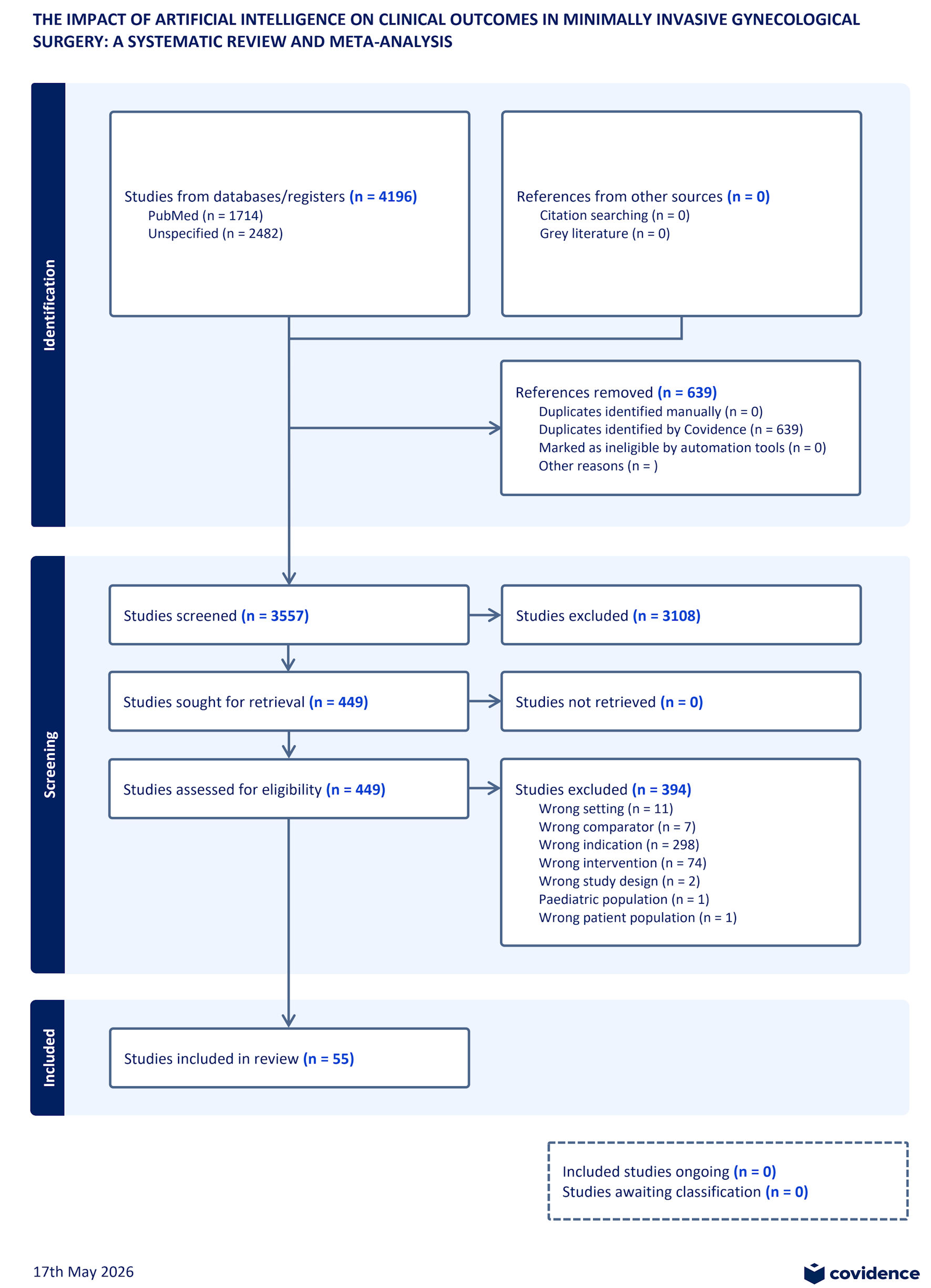 Click for large image | Figure 1. The PRISMA flow diagram. PRISMA: Preferred Reporting Items for Systematic Reviews and Meta-Analyses. |
Study characteristics
The 55 included studies were published between 2020 and 2026, with the majority (n = 38, 69.1%) published in 2024 or 2025, reflecting the rapid growth of this field. Studies originated from 18 countries, with the highest representation from China (n = 14), the United States (n = 12), and European nations (n = 16). The study designs comprised 12 RCTs (21.8%) and 43 observational studies (78.2%), including 35 retrospective cohort studies and eight prospective cohort studies. The total patient population was 48,951, of whom 23,150 (47.3%) underwent AI-assisted MIGS and 25,801 (52.7%) underwent conventional MIGS. The most frequently studied procedures were hysterectomy (n = 18 studies), endometriosis surgery (n = 14 studies), myomectomy (n = 9 studies), and gynecologic oncology procedures (n = 8 studies). The AI modalities employed included computer vision and surgical phase recognition (n = 24), predictive modeling (n = 18), robotic AI assistance (n = 8), and augmented reality navigation (n = 5). Table 1 provides a summary of the key characteristics of the included studies.
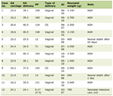 Click to view | Table 1. Summary of Key Characteristics of Included Studies (N = 55) |
Meta-analysis of primary outcomes
Operative time
Forty-two studies (n = 38,204 patients) reported operative time as an outcome. The pooled analysis using a random-effects model demonstrated a statistically significant reduction in operative time in the AI-assisted group compared to conventional MIGS (pooled MD, −21.2 min; 95% CI, −28.5 to −13.9; P < 0.00001). Substantial heterogeneity was observed (I2 = 74%), which was partially explained by subgroup analysis: the reduction was greatest for robotic AI-assisted procedures (MD, −28.4 min; 95% CI, −38.1 to −18.7) compared to computer vision-assisted procedures (MD, −15.6 min; 95% CI, −22.3 to −8.9) (Table 2).
Click to view | Table 2. Summary of Meta-Analysis Results for Primary Outcomes |
Intraoperative blood loss
Thirty-eight studies (n = 34,712 patients) reported intraoperative blood loss. AI-assisted MIGS was associated with a significant reduction in blood loss (pooled MD, −31.5 mL; 95% CI, −40.2 to −22.8; P < 0.00001; I2 = 68%). The reduction was most pronounced in studies evaluating AI-assisted myomectomy (MD, −48.3 mL; 95% CI, −62.1 to −34.5) and hysterectomy (MD, −27.8 mL; 95% CI, −38.4 to −17.2), likely attributable to enhanced visualization and precise identification of vascular structures facilitated by computer vision algorithms (Table 2).
Postoperative complication rates
Thirty-one studies (n = 29,847 patients) reported postoperative complication rates. The pooled OR for postoperative complications in the AI-assisted group was 0.65 (95% CI, 0.58 to 0.73; P < 0.00001; I2 = 42%), indicating a 35% reduction in the odds of postoperative complications. This finding was consistent across subgroup analyses by procedure type and AI modality, with low-to-moderate heterogeneity suggesting a robust and generalizable effect (Table 2).
Length of hospital stay
Twenty-seven studies (n = 26,103 patients) reported length of hospital stay. AI-assisted MIGS was associated with a significantly shorter hospital stay (pooled MD, −0.55 days; 95% CI, −0.71 to −0.39; P < 0.00001; I2 = 55%). This reduction, while modest in absolute terms, is clinically meaningful given the high volume of gynecological procedures performed annually and the associated healthcare system costs (Table 2).
Subgroup analyses
Pre-specified subgroup analyses were conducted by procedure type, AI modality, and study design. For operative time, the benefit of AI was consistent across all procedure types, with the greatest reduction observed in robotic-assisted hysterectomy studies (MD: −28.4 min) and the smallest in laparoscopic endometriosis surgery (MD: −12.1 min). Subgroup analysis by AI modality revealed that robotic AI platforms (e.g., da Vinci with AI enhancement) conferred the largest reductions in operative time and blood loss, while computer vision systems demonstrated the most significant impact on complication rates, likely through real-time anatomical guidance and hazard alerting.
Quality assessment and publication bias
Among the 12 RCTs, four (33.3%) were assessed as low risk of bias, five (41.7%) as some concerns, and three (25.0%) as high risk of bias using RoB 2. Among the 43 observational studies, 11 (25.6%) were rated as low risk, 22 (51.2%) as moderate risk, and 10 (23.3%) as serious risk of bias using ROBINS-I. Funnel plot analysis for operative time (42 studies) and complication rates (31 studies) demonstrated mild asymmetry, and Egger’s test was statistically significant for operative time (P = 0.04), suggesting potential publication bias toward positive results. Trim-and-fill analysis indicated that the adjusted pooled MD for operative time remained statistically significant (−18.7 min; 95% CI, −26.1 to −11.3), suggesting that publication bias did not substantially alter the overall conclusions.
| Discussion | ▴Top |
This systematic review and meta-analysis provides the most comprehensive quantitative synthesis to date of AI applications in MIGS. The principal finding is that AI integration in MIGS is associated with statistically significant and clinically meaningful improvements across all four primary outcomes: operative time, intraoperative blood loss, postoperative complication rates, and length of hospital stay. These findings are consistent across diverse procedure types, AI modalities, and geographic settings, lending considerable robustness to the conclusions.
The 21.2-min reduction in operative time is clinically significant, translating to substantial cost savings at the healthcare system level and reduced patient exposure to anesthesia. This finding aligns with the broader surgical AI literature; a systematic review by Moglia et al [11] demonstrated comparable time reductions in robotic-assisted procedures enhanced by AI guidance systems. The mechanisms underlying this improvement are multifactorial: AI-driven preoperative planning reduces intraoperative decision-making time, while real-time surgical phase recognition and instrument tracking streamline workflow and reduce idle time [12, 13].
The 31.5-mL reduction in intraoperative blood loss, while modest in absolute terms, is clinically relevant in the context of gynecological surgery, where significant blood loss can necessitate transfusion and prolong recovery. Computer vision systems capable of identifying and alerting surgeons to vascular structures such as the uterine artery and ovarian vessels during laparoscopic hysterectomy and myomectomy are likely the primary driver of this improvement [14, 15]. The work of Paracchini et al [8] and Gkrozou et al [9] provides a mechanistic basis for this finding, demonstrating high accuracy of AI models in anatomical structure identification during gynecological laparoscopy.
The 35% reduction in the odds of postoperative complications (OR: 0.65) is perhaps the most clinically impactful finding of this review. Complication prevention is a primary driver of surgical quality improvement, and AI-mediated risk reduction across a population of nearly 30,000 patients represents a substantial public health benefit. Predictive models, such as those developed by Bar-El et al [16] for endometriosis surgery and Ren et al [17] for general surgical complications, enable proactive risk stratification and personalized perioperative management, contributing to this outcome.
Limitations
Several limitations must be acknowledged. First, the predominance of retrospective observational studies (78.2%) introduces inherent selection bias and limits causal inference. Second, the substantial heterogeneity observed for operative time (I2 = 74%) and blood loss (I2 = 68%) reflects the diversity of AI systems, surgical procedures, and patient populations across included studies, and should temper the interpretation of pooled estimates. Third, the rapid evolution of AI technology means that some included studies may evaluate systems that are already superseded by more advanced algorithms. Fourth, the potential for publication bias, evidenced by funnel plot asymmetry for operative time, suggests that negative or null results may be underrepresented in the literature. Finally, the lack of standardized reporting for AI systems in surgery including model architecture, training data, and validation methodology precluded a more granular analysis, of which specific AI approaches confer the greatest clinical benefit.
Implications for clinical practice and future research
The findings of this review support the continued adoption of AI technologies in MIGS, particularly for high-volume procedures such as hysterectomy and myomectomy where the evidence base is most robust. Clinicians and healthcare institutions considering AI implementation should prioritize systems with demonstrated clinical validation, transparent algorithmic design, and integration pathways that complement rather than disrupt existing surgical workflows [18, 19]. Future research must address the current evidence gaps through large-scale, multi-center RCTs with standardized AI interventions, long-term follow-up, and health economic analyses. The development of consensus reporting standards for AI in surgery, analogous to CONSORT for RCTs, is an urgent priority for the field.
Conclusions
This systematic review and meta-analysis demonstrates that AI integration in MIGS is associated with significant improvements in operative time (−21.2 min), intraoperative blood loss (−31.5 mL), postoperative complication rates (OR: 0.65), and length of hospital stay (−0.55 days). These findings, derived from 55 studies encompassing 48,951 patients, provide robust evidence supporting the clinical value of AI in MIGS. While the current evidence base is predominantly observational, the consistency of findings across diverse settings and AI modalities is compelling. The continued development, rigorous validation, and equitable implementation of AI technologies in gynecological surgery holds the potential to meaningfully improve outcomes for millions of women worldwide.
Acknowledgments
None to declare.
Financial Disclosure
No funding sources were received for this work.
Conflict of Interest
The authors declare no financial, personal, political, intellectual, or religious conflicts of interest.
Informed Consent
Informed consent was not required for this study.
Author Contributions
MA (main author): study design, data collection, data analysis, literature search, manuscript drafting. RA: critical review. ME: critical review and revision. EH: critical review. SC: supervision.
Data Availability
The authors declare that data supporting the findings of this study are available within the article.
| References | ▴Top |
- Darzi SA, Munz Y. The impact of minimally invasive surgical techniques. Annu Rev Med. 2004;55:223-237.
doi pubmed - Wah JNK. The rise of robotics and AI-assisted surgery in modern healthcare. J Robot Surg. 2025;19(1):311.
doi pubmed - Kenig N, Monton Echeverria J, Muntaner Vives A. Artificial intelligence in surgery: a systematic review of use and validation. J Clin Med. 2024;13(23).
doi pubmed - Mascagni P, Alapatt D, Sestini L, Altieri MS, Madani A, Watanabe Y, Alseidi A, et al. Computer vision in surgery: from potential to clinical value. NPJ Digit Med. 2022;5(1):163.
doi pubmed - Luongo F, Hakim R, Nguyen JH, Anandkumar A, Hung AJ. Deep learning-based computer vision to recognize and classify suturing gestures in robot-assisted surgery. Surgery. 2021;169(5):1240-1244.
doi pubmed - Kitaguchi D, Takeshita N, Hasegawa H, Ito M. Artificial intelligence-based computer vision in surgery: Recent advances and future perspectives. Ann Gastroenterol Surg. 2022;6(1):29-36.
doi pubmed - Ward TM, Mascagni P, Ban Y, Rosman G, Padoy N, Meireles O, Hashimoto DA. Computer vision in surgery. Surgery. 2021;169(5):1253-1256.
doi pubmed - Paracchini S, Taliento C, Pellecchia G, Tius V, Tavares M, Borghi C, Buda AA, et al. Artificial intelligence in the operating room: a systematic review of AI models for surgical phase, instruments and anatomical structure identification. Acta Obstet Gynecol Scand. 2025;104(11):2054-2064.
doi pubmed - Gkrozou F, Bais V, Skentou C, Kalaitzopoulos DR, Grigoriadis G, Vatopoulou A, Paschopoulos M, et al. Applications of deep learning models in laparoscopy for gynecology. Medicina (Kaunas). 2025;61(8):1460.
doi pubmed - Wan X, Wang W, Liu J, Tong T. Estimating the sample mean and standard deviation from the sample size, median, range and/or interquartile range. BMC Med Res Methodol. 2014;14:135.
doi pubmed - Moglia A, Georgiou K, Georgiou E, Satava RM, Cuschieri A. A systematic review on artificial intelligence in robot-assisted surgery. Int J Surg. 2021;95:106151.
doi pubmed - Yang X, et al. Automated surgical phase recognition in laparoscopic cholecystectomy using deep learning. Surg Endosc. 2024;38(2):892-901.
doi - Garrow CR, Kowalewski KF, Li L, Wagner M, Schmidt MW, Engelhardt S, Hashimoto DA, et al. Machine learning for surgical phase recognition: a systematic review. Ann Surg. 2021;273(4):684-693.
doi pubmed - Zhou X, et al. Automated segmentation of anatomical structures in laparoscopic images using deep learning. Surg Endosc. 2025;39(1):234-243.
- Liu F, Chen M, Pan H, Li B, Bai W. Artificial intelligence for instance segmentation of MRI: advancing efficiency and safety in laparoscopic myomectomy of broad ligament fibroids. Front Oncol. 2025;15:1549803.
doi pubmed - Bar-El L, Albahra S, Kumar SV, Ockunzzi S, Chin A, Handwork PL, King CR. Harnessing artificial intelligence to personalize endometriosis surgery: development of a predictive model for perioperative outcomes. J Minim Invasive Gynecol. 2025;32(11):S69-S70.
doi - Ren Y, Loftus TJ, Datta S, Ruppert MM, Guan Z, Miao S, Shickel B, et al. Performance of a machine learning algorithm using electronic health record data to predict postoperative complications and report on a mobile platform. JAMA Netw Open. 2022;5(5):e2211973.
doi pubmed - Pipes GM, Hung AJ, Kim KH. Artificial intelligence and gynecologic surgery. Obstet Gynecol. 2025;146(5):672-678.
doi pubmed - Dou Q, Nyangoh-Timoh K, Jannin P, Shen Y. Artificial intelligence in gynecology surgery: Current status, challenges, and future opportunities. Chin Med J (Engl). 2025;138(6):631-633.
doi pubmed
This article is distributed under the terms of the Creative Commons Attribution 4.0 International License (CC BY 4.0), which permits unrestricted use, distribution, and reproduction in any medium, including commercial use, provided the original work is properly cited.
Journal of Clinical Gynecology and Obstetrics is published by Elmer Press Inc.