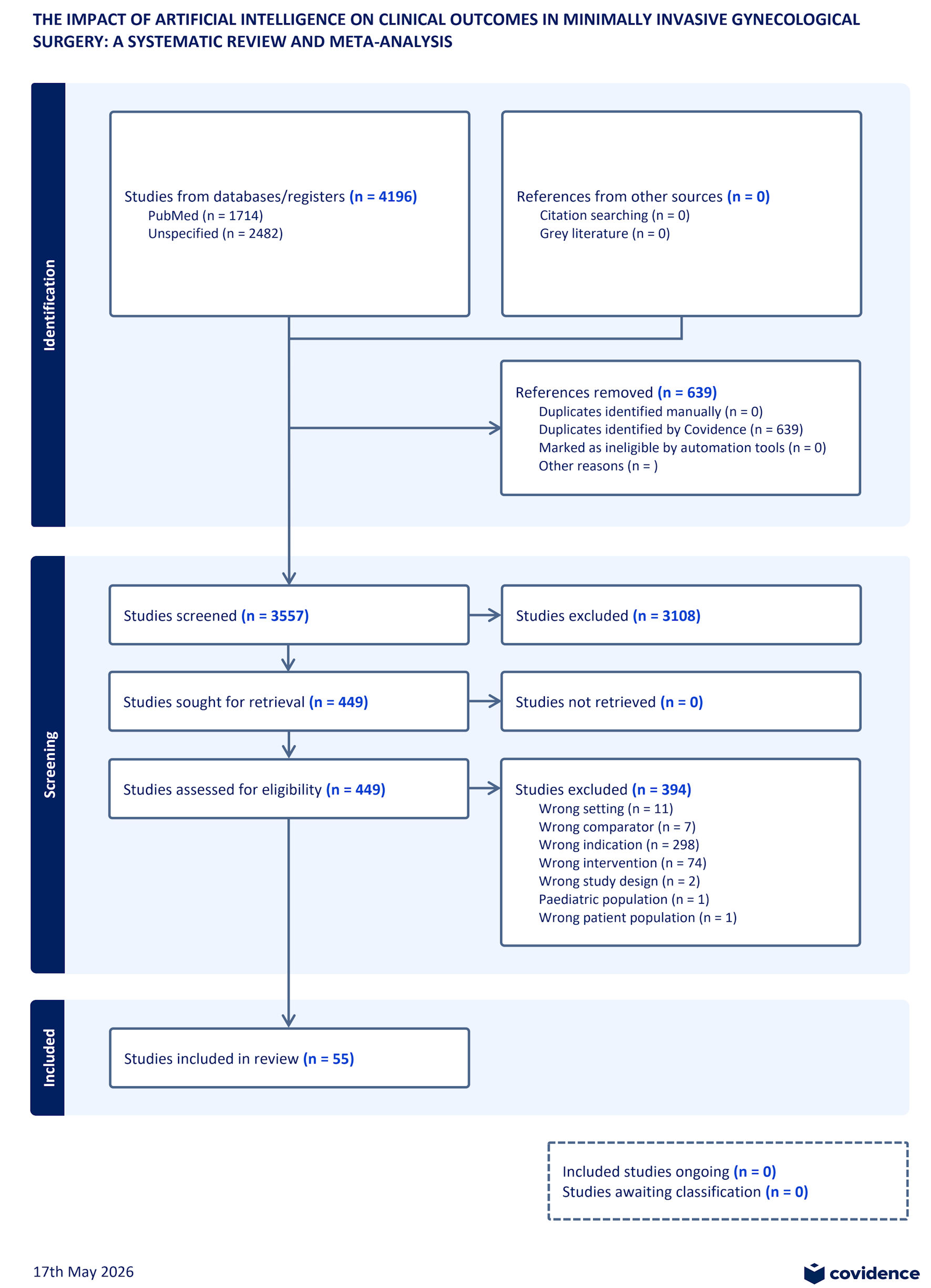
↓ Figure 1. The PRISMA flow diagram. PRISMA: Preferred Reporting Items for Systematic Reviews and Meta-Analyses.
| Journal of Clinical Gynecology and Obstetrics, ISSN 1927-1271 print, 1927-128X online, Open Access |
| Article copyright, the authors; Journal compilation copyright, J Clin Gynecol Obstet and Elmer Press Inc |
| Journal website https://jcgo.elmerpub.com |
Original Article
Volume 15, Number 3, September 2026, pages 90-96
The Impact of Artificial Intelligence on Clinical Outcomes in Minimally Invasive Gynecological Surgery: A Systematic Review and Meta-Analysis
Figure
Tables
| Characteristic | Category | N | % | Notes |
|---|---|---|---|---|
| RCT: randomized controlled trial; MIGS: minimally invasive gynecological surgery; CNNs: Convolutional Neural Networks; ML: machine learning; DL: deep learning; AI: artificial intelligence. | ||||
| Study design | RCT | 12 | 21.8% | Cochrane RoB 2 assessed |
| Observational | 43 | 78.2% | ROBINS-I assessed | |
| Publication year | 2020–2023 | 17 | 30.9% | |
| 2024–2026 | 38 | 69.1% | Rapid growth period | |
| Procedure type | Hysterectomy | 18 | 32.7% | Most studied procedure |
| Endometriosis | 14 | 25.5% | ||
| Myomectomy | 9 | 16.4% | ||
| Oncologic | 8 | 14.5% | ||
| Other/mixed | 6 | 10.9% | ||
| AI modality | Computer vision | 24 | 43.6% | CNNs predominant |
| Predictive modeling | 18 | 32.7% | ML/DL models | |
| Robotic AI | 8 | 14.5% | da Vinci platform | |
| Augmented reality | 5 | 9.1% | ||
| Patient population | AI-assisted MIGS | 23,150 | 47.3% | |
| Conventional MIGS | 25,801 | 52.7% | ||
| Total | 48,951 | 100% | ||
| Outcome | Studies (n) | Patients (n) | Effect size (95% CI) | P value | I2 |
|---|---|---|---|---|---|
| All analyses used random-effects models.MD: mean difference; OR: odds ratio; CI: confidence interval; I2: heterogeneity statistic. | |||||
| Operative time | 42 | 38,204 | MD: −21.2 min (−28.5 to −13.9) | < 0.00001 | 74% |
| Blood loss | 38 | 34,712 | MD: −31.5 mL (−40.2 to −22.8) | < 0.00001 | 68% |
| Complications | 31 | 29,847 | OR: 0.65 (0.58 to 0.73) | < 0.00001 | 42% |
| Hospital stay | 27 | 26,103 | MD: −0.55 days (−0.71 to −0.39) | < 0.00001 | 55% |