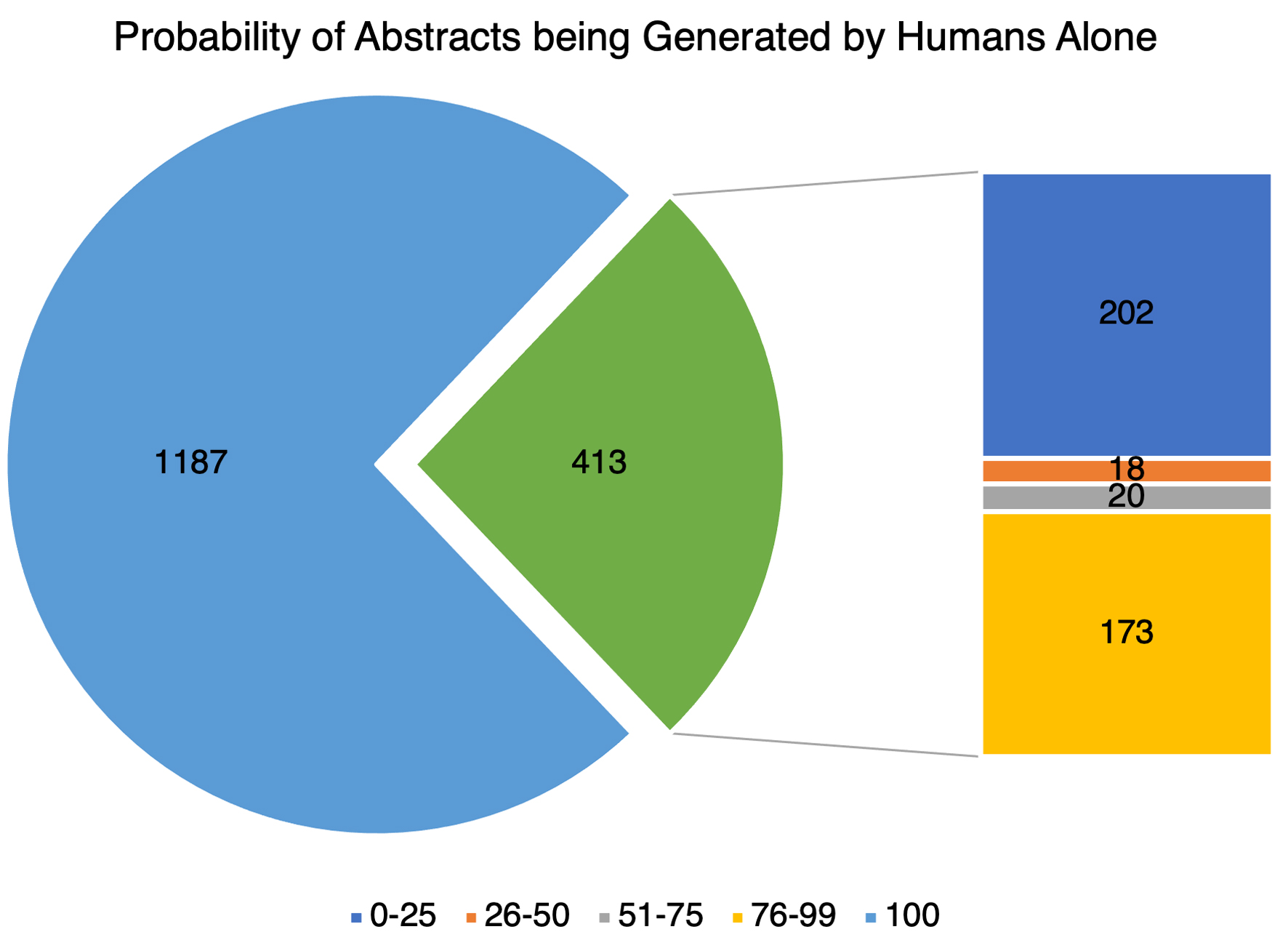
↓ Figure 1. Distribution of percentages of human-written text across 1,600 abstracts.
| Journal of Clinical Gynecology and Obstetrics, ISSN 1927-1271 print, 1927-128X online, Open Access |
| Article copyright, the authors; Journal compilation copyright, J Clin Gynecol Obstet and Elmer Press Inc |
| Journal website https://jcgo.elmerpub.com |
Original Article
Volume 15, Number 2, June 2026, pages 49-54
Detection of AI Influence Within Women’s Health Literature
Figures
Table
| ObGyn | FP | REI | GynOnc | Gyn | MFM | χ2, df, P-value | |
|---|---|---|---|---|---|---|---|
| AI: artificial intelligence; df: degrees of freedom; FP: family planning; Gyn: benign gynecologic subspecialties; GynOnc: gynecologic oncology; MFM: maternal fetal medicine; ObGyn: obstetrics and gynecology; REI: reproductive endocrinology and infertility. | |||||||
| Total abstracts (n = 1,600) | 740 | 60 | 220 | 160 | 60 | 360 | |
| 100% human detection | 552 (74.6%) | 56 (93.3%) | 143 (65%) | 120 (75%) | 43 (71.7%) | 273 (75.8%) | χ2 24.1, df 5, P < 0.05 |
| ≥ 1% AI detection | 188 (25.4%) | 4 (6.7%) | 77 (35%) | 40 (25%) | 17 (28.3%) | 87 (24.2%) | χ2 94, df 5, P < 0.05 |
| 100% AI detection | 43 (5.8%) | 2 (3.3%) | 11 (5%) | 6 (3.8%) | 1 (1.7%) | 16 (4.4%) | χ2 11.6, df 5, P < 0.05 |
| Average proportion of AI-influenced text within each abstract (n = 413) | 57.4% | 70.8% | 52.1% | 55.1% | 43.5% | 53.8% | χ2 7.3, df 5, P = 0.20 |